Barbados’ key tax adviser is urging the island to redouble efforts to expand its tax treaty network as it aligns further with the global minimum tax (GMT) structure demanded by G7 nations.
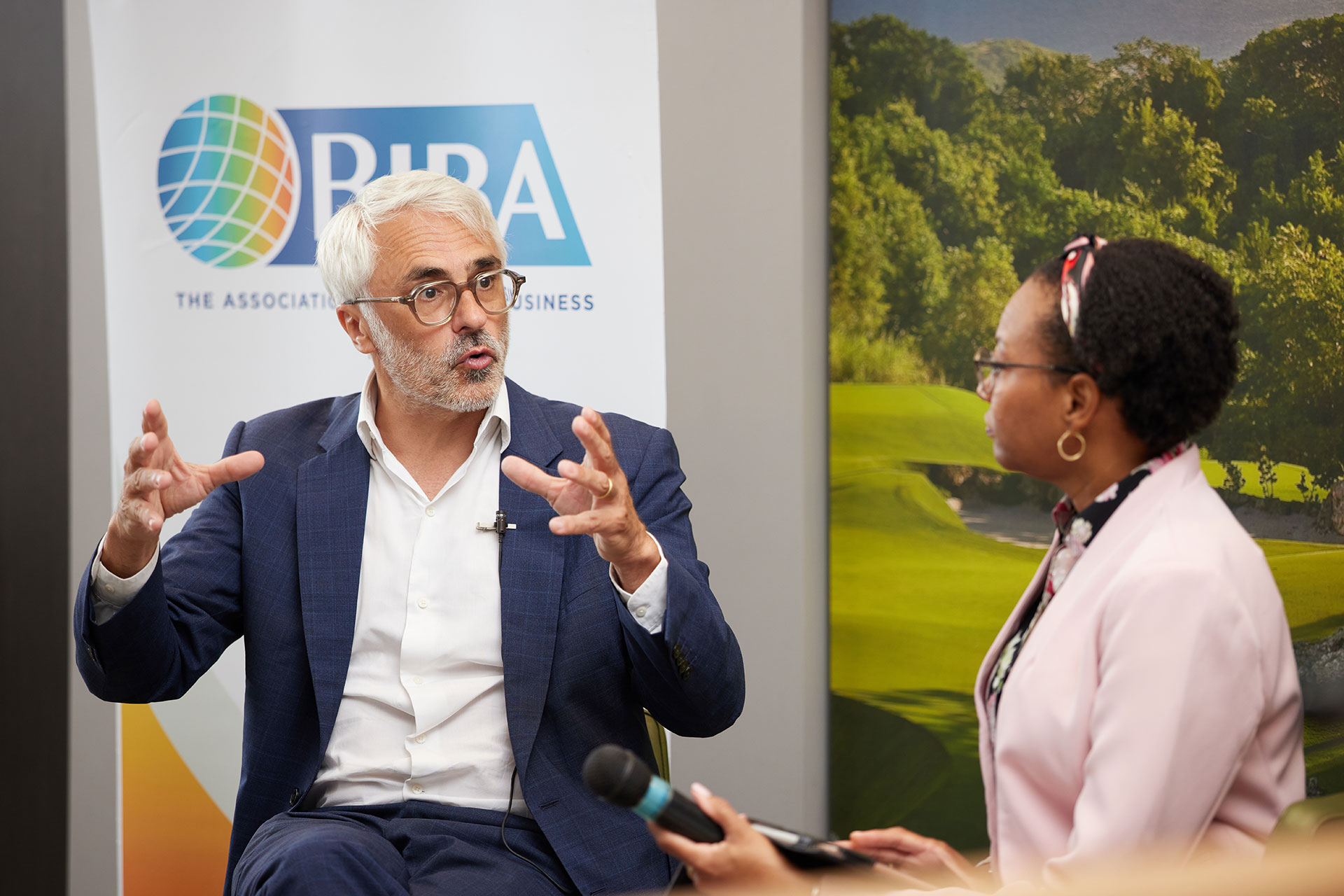
Pascal Saint-Amans, special adviser to Prime Minister Mia Mottley on taxation-related matters, offered this assessment while addressing a recent session for members of BIBA, the Association for Global Business, at the Regus Business Centre in Welches, St Thomas.
The Frenchman argued that tax treaties had not become obsolete simply because Barbados had raised its corporate tax rate and introduced a top-up tax aligned with the effective 15 per cent GMT for multinational companies with global revenues of at least €750 million (US$864 million). The measure was introduced by the Organisation for Economic Cooperation and Development (OECD) to discourage companies from shifting profits to low-tax jurisdictions.
Saint-Amans, a former Director of the Centre for Tax Policy and Administration at the OECD, was speaking recently during BIBA’s Coffee & Conversation forum.
“Do we need tax treaties? It’s absolutely essential, now that we are in a regular type of corporate income tax. . . We have a regular tax system . . . with low taxation on insurance business,” he outlined.
He asserted: “We badly need a strong, dense treaty network, because there is a risk of double taxation. And that’s my line with the Prime Minister, the government, with the Barbados Revenue Authority, and with business units such as you here, to say we now must provide you, taxpayers, service providers with absolute tax certainty. With the elimination of the low taxation, and in the new world, this can bring more substance,” he asserted.
Saint-Amans, who began formally advising Barbados on international tax matters in 2022, also urged the island to ensure it preserves its tax treaty with the United States.
Amid shifting geopolitical dynamics, he reiterated the need for Barbados to remain prepared to capitalise on emerging opportunities.
“We don’t really know what’s going to happen in Venezuela, but still the economy is opening. We don’t exactly know when Cuba will be opening, but it’s going to pop up. . . . Will the big investors put their money directly in Venezuela? . . .
“We are in the place where we have the treaty network, including with the United States, Canada, and we have the Netherlands. We must have more in Europe.
“Venezuela, I take that as one example, but it’s a big one. . . . a big economy, [that] can just bring Barbados a big amount of good business, . . . but also by putting substance here,” he told a cross-section of senior executives and professionals in the global business community.
Noting that tax credits cannot be accessed by companies without actual substance on the ground in Barbados, Saint-Amans emphasised that, in the absence of a low-tax advantage, the island must focus on attracting and building “real business here with more substance”.
Making his case for an expanded treaty and investment network, he argued that Barbados could remain an attractive jurisdiction even as the economies of Venezuela and Cuba reopen and compete for new investment.
“With a dense, large-coverage treaty network, we can attract massive business here. We need to develop the treaty network.
Saint-Amans said the island was revising its model treaty and he has advised “to have a model which is purely based on the OECD, not because I [came] from the OECD, but because Barbados, despite being a member of the G77 and belonging to the group of developing countries, we are an investment hub”.
At the same time, Saint-Amans described Africa as “the next frontier” as Barbados actively builds out its tax treaty network.
He disclosed that he will now be part of the island’s tax treaty negotiating team, which is seeking to establish tax agreements with “as many countries as possible”.
Touching on the agreement with Canada, Saint-Amans acknowledged that Canada had hinted at interest in renegotiating the avoidance of double taxation pact, although he acknowledged concerns about reopening it as the possibility existed that Canada may seek changes that might not be to the island’s advantage. For this reason, he said he wanted to hear from BIBA members what they thought would be in their best interest should the treaty be opened up to renegotiation.
“Your input would be extremely valuable. The treaty with Canada – you know the history of it; you know its importance for turning Barbados into one of the important players in the global map,” he stated, adding, “With the global minimum tax, we must ensure that our treaty partners give us the treaty benefits.”
By Geralyn Edward for BIBA, the Association for Global Business