
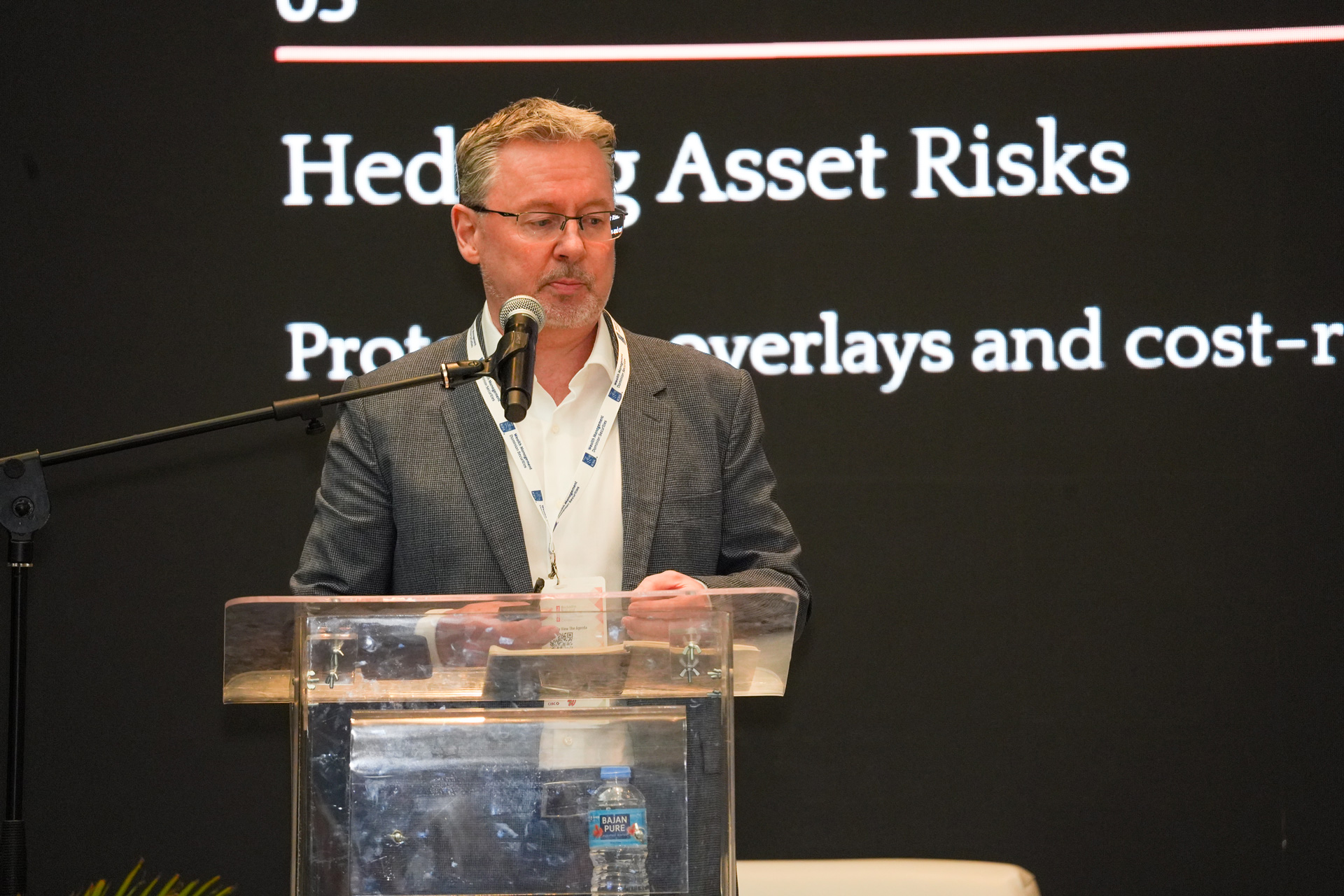
Local insurers have been encouraged to explore Asset Liability Matching (ALM) as a strategy to hedge against the risks prompted by evolving natural and geopolitical hazards.
This was highlighted by global insurance asset management consultant Chris Howells as he addressed the Barbados Risk & Insurance Management (BRIM) Conference held at the Wyndham Grand Barbados Sam Lord’s Castle, and hosted by BIBA, the Association for Global Business.
Howells underscored the growing complexity of ALM describing it as the practice of aligning the sale of assets with projected liabilities to ensure obligations are met without adverse market conditions leading to forced sales.
He highlighted the increasing role that ALM is playing in insurers’ financial stability as premium income takes a backseat to the increasing role of bonds, derivatives, and infrastructure debt in shaping insurer portfolios.
“At its core, ALM is about ensuring your assets generate cash flows in line with your liabilities as they fall due,” he explained. “This avoids costly disruptions and protects portfolio integrity.”
Howells was among the list of high-profile speakers who addressed hundreds of local, regional and international delegates at the sixth annual symposium.
Howells, the former Head of International Insurance Solutions at Macquarie Asset Management, noted that traditional ALM approaches were rapidly evolving from “set and forget” strategies to more dynamic, data-driven models, driven in part by global regulatory shifts toward risk-based capital frameworks. These changes, he said, are requiring more frequent reporting and deeper understanding of investment risks across jurisdictions.
He pointed to a growing global trend toward increased allocation to private markets, which, while offering enhanced returns, introduced added complexity, illiquidity, and heightened reporting requirements.
Despite these shifts, Howells stressed that government and high-grade corporate bonds continue to form the “bedrock” of most insurance portfolios. However, he observed there a gradual reallocation from government securities to investment-grade corporate bonds was occurring, as insurers sought additional yield while avoiding the capital penalties associated with high-yield assets.
Derivatives, he noted, play an important but challenging role in risk management strategies.
“Hedging decisions are not straightforward,” Howells said. “They can be costly, require collateral, and in some markets, the necessary instruments may not even be available.” He added that insurers must carefully weigh the cost of hedging against the risks they choose to retain.
Highlighting emerging asset classes, Howells pointed to the rising importance of infrastructure debt, particularly as it aligns with environmental, social, and governance (ESG) objectives. He noted that insurers are increasingly investing in climate-focused infrastructure as part of broader sustainable investment strategies.
“ESG considerations are now at the forefront of both regulatory thinking and insurer strategy,” he said. “Firms recognize that sustainable investing can deliver long-term value for policyholders and shareholders, even as they navigate inherent trade-offs between environmental and social priorities.”
Howells also highlighted the growing use of securitised assets and the gradual shift from public to private investments, reflecting a broader search for yield in a constrained environment.
He told BRIM delegates that successful ALM requires balancing multiple competing objectives, including return optimisation, capital efficiency, liquidity, and regulatory compliance.
The BRIM Conference in Barbados continues to serve as a key platform for advancing dialogue on risk and insurance management across the Caribbean and beyond.
By Geralyn Edward for BIBA, the Association for Global Business